Marcel Duchamp vs Regina Galindo
Amalia Cross
Published the 20 April 2022
Illustration by Danila Ilabaca
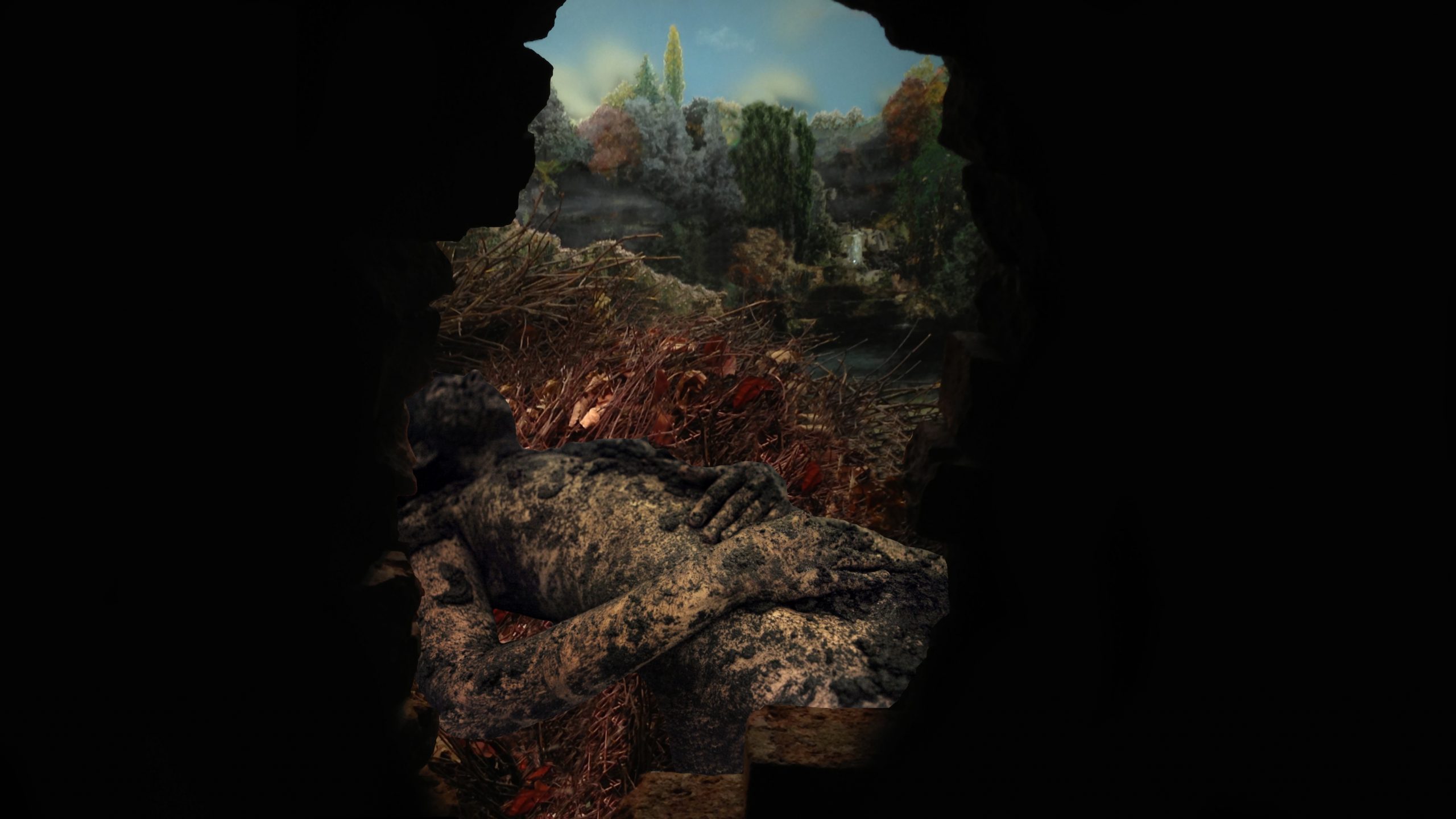
Marcel Duchamp went down in history for opening the playing field of art: he painted Nude Descending a Staircase, intervened the Mona Lisa with mustaches and dressed himself as a woman, thus inventing a feminine alter ego. Before what is, perhaps, the strangest or most ambiguous of all his works, a series of uncomfortable questions arise about the representation of a woman’s naked body and about the viewer’s participation in the work of art.
The Art Game is the name given to a deck of thirty-two cards printed with the faces of famous artists. Along with their names we find a brief biography and a scoring system that determines, in six categories, their importance and a curious scale of contemporary art: influence, “novelty” effect or impact, versatility, auction sale record expressed in millions of dollars, critical reception and the “beauty” factor. The criteria that determine art, in this game, as well as the very selection of artists that populate the deck, are questionable, but –remember– it is only a game. The game –as it happens in this section of the magazine Art on Trial– consists of pitting one artist against another. The cards are dealt and the player who wins the game is the one who has the artist with the highest score.
The game –as it happens in this section of the magazine Art on Trial– consists of pitting one artist against another.
In this game – created by Mikkel Sommer and James Cahill in 2014 – the artist with the highest scores is not Picasso, Pollock, Warhol or Koons, but Marcel Duchamp (98 in influence, 99 in novelty, 80 in versatility, 11.4 M $ USD, 91 in critical reception, 29 in beauty factor). Along with the image of a skinny man, wearing a tie and fur coat, it reads: “The father of Dada, Duchamp revolutionized art with his inverted urinal, Fountain (1917). In 1913 he abandoned painting for the ready-mades, and later abandoned the ready-mades for chess; in the meantime, he was working on the surreal ‘psycheptic show’ entitled Étant donnés.”
This work, Étant donnés: 1. la chute d’eau / 2. le gaz d’éclairege (Given: 1. the waterfall / 2. the lighting gas, 1946-1966), was exhibited for the first time a year after Duchamp’s death, in 1969, at the Philadelphia Museum of Art. The work was mounted, following the artist’s will, without prior notice: the press raised a cry and the public lined up. In front of the Étant donnés, Calvin Tomkins tells us, “the viewer becomes a voyeur.” Faced with “the strangest work of art in the entire museum” (Calvin Tomkins, Duchamp. Barcelona: Anagrama, 1999, p. 499), according to Jasper Johns, critics and fans of the artist were uncomfortable and left speechless. And the artist said nothing; instead, there was absolute silence beyond the grave.
The spectator enters the room and approaches the work in silence; the first thing he finds is a brick wall with a wooden door and two locks through which he can look out from. What he sees is an erotic and disturbing scene: the naked body of a woman with her legs spread, sex in view, devoid of hair, lying on a wooded landscape with a lamp lit in her left hand and further back, in the last shot, a waterfall. The posture of her body has been interpreted as one acquired after intercourse, after having been possessed – with or without consent? – by someone; in this case, by the “ideal” spectator, assumed by the tradition of the art of the nude always as masculine, a voyeur whose imagination runs like the waterfall in the background.
In silence, “alone and in secret”, Duchamp worked for the last 20 years of his life at the Étant donnés, and he also remained quiet as to Elsa von Freytag-Loringhover’s participation in the creation of La Fuente. An omission that took from the game board and from the history of art the baroness – Dadaist, poet and artist – who sent the urinal to the Armory Show in 1917. But, as Joseph Beuys said (73 in influence, 74 in novelty, 66 in versatility, 0.9 M $ USD, 68 in critical reception, 41 in beauty factor): Duchamp’s silence is overrated.
Although Duchamp said nothing, we know that in this work the woman has neither head nor tail.
Although Duchamp said nothing, we know that in this work the woman has neither head nor tail. Or, as Jean Clair put it – thinking of The Big Glass and the Urinal – it is the result of a mixture of “cynical eroticism”, “frustration” and “lowering of women” (Jean Clair, De immundo. Madrid: Arena libros, 2007, pp. 31-32.). Here the woman appears as a motionless piece of meat: an incomplete volume covered with pigskin. A nude enclosed in a three-dimensional painting. And, as such, it is the representation of a passive woman willing, as an object, to be contemplated. Without a face, she cannot look back (while the viewers are seen by others while they watch). Without feet, she has no possibility of movement or action. But what if, suddenly, that woman’s body reacts? If she woke up from her dream state? If she could speak or question the viewer? That woman would stand up, shake her wet and aching body, covered with dirt, branches and dry leaves, to get out of there and walk home. Obviously, this operation goes beyond the three-dimensionality of Duchamp’s work (and intentions). And yet, it allows us to elucidate other possible readings in the body of other artists who, through performance, have addressed sexual violence against women. Among all of them, Regina José Galindo.
In Galindo’s works “the passive position of the public as an observer is replaced by the action of participating.” In Alud, a 2011 performance, she lies naked, lying on a stretcher, while the audience cleans her body covered in mud using cloths and water. The proximity to the artist’s body and the inclusion of touch ends with the viewer’s position that only observes without getting involved. In this work, she breaks with the voyeurism promoted by retinal art that appeals only to the visual. A type of art that Duchamp detested, but which –contradictorily– has its climax in the Étant donnés.
In Galindo’s performance, a different relationship between artist and audience is proposed. Before the artist’s body, the viewer feels empathy and the need to do something more for that body, for the body of a woman who suffered a catastrophe (an avalanche). In Alud, the metal stretcher is like the cold surface of a morgue where lifeless bodies arrive awaiting an autopsy to determine identity and cause of death. But when it comes to women’s bodies, the cause is almost always the same. There are countless cases of women that are murdered, strangled, stabbed, repeatedly raped and abandoned in open fields, garbage dumps or wastelands. And there are others, like the dead in Juárez that Roberto Bolaño recounts in his novel 2666, “that no one ever found, buried in mass graves in the desert or scattered their ashes in the middle of the night.” (Roberto Bolaño, 2666. Barcelona: Anagrama, 2004, p. 444)
In Galindo's performance, a different relationship between artist and audience is proposed.
To understand the response that the artist wants to provoke in Alud, we can turn to other of her works. In Pain in a Handkerchief (1999), Galindo is tied to a bed, blindfolded, naked, and her pubic hair shaved. Her nudity is contrary to that of Duchamp and tradition, because she is not erotic but stark, because she does not give pleasure but pain. Her thin body is the support on which the headlines of the newspapers of Guatemala, her native country, are projected: “thirty rapes in just two months”, “they murder a woman, they leave a body in Planes de Minerva”. That body, like many others, was thrown in a landscape, thrown in a vacant place, on the margins of the city, after having been outraged. And in La siesta, a 2016 performance, Galindo falls asleep after consuming, in a glass of wine, 10 milliliters of a hypnotic drug used to perform silent rapes. Her body collapses on a mattress and sleeps until two men wake her by throwing buckets of cold water on her face. The viewer, now, is a witness and is involved in the scene of a crime, because these experiences –as painful as they are daily– become a body of work and a complaint. Both in these works, as in Alud, the viewer is torn between pretending that he has not seen anything or coming to the aid of that woman.
For Duchamp, the “creative act is not something that only the artist performs” but requires spectators to happen. For Galindo too, but she seems to put into action the work that Duchamp left in suspense, as an erotic fantasy, or as a perversion, in the mind of the spectator. In this sense, the artist takes up the position of the naked-woman-reclining to subvert or modify the relationship with the viewer, questioning her behavior and her historical identity. Despite this, the biggest difference between the two artists continues to be that a woman cannot remain silent, their life often depends on the possibility of speaking, shouting, not remaining silent: “For each one who denounces, seven are silent. ”
Regina José Galindo is not in the deck. There are only four female artists and only one of them is Latin American. But if she were there: who would win? Her or Duchamp? You decide.