Manet vs Meissonier
Christian Viveros-Fauné
Published the 31 March 2021
Illustration by Danila Ilabaca
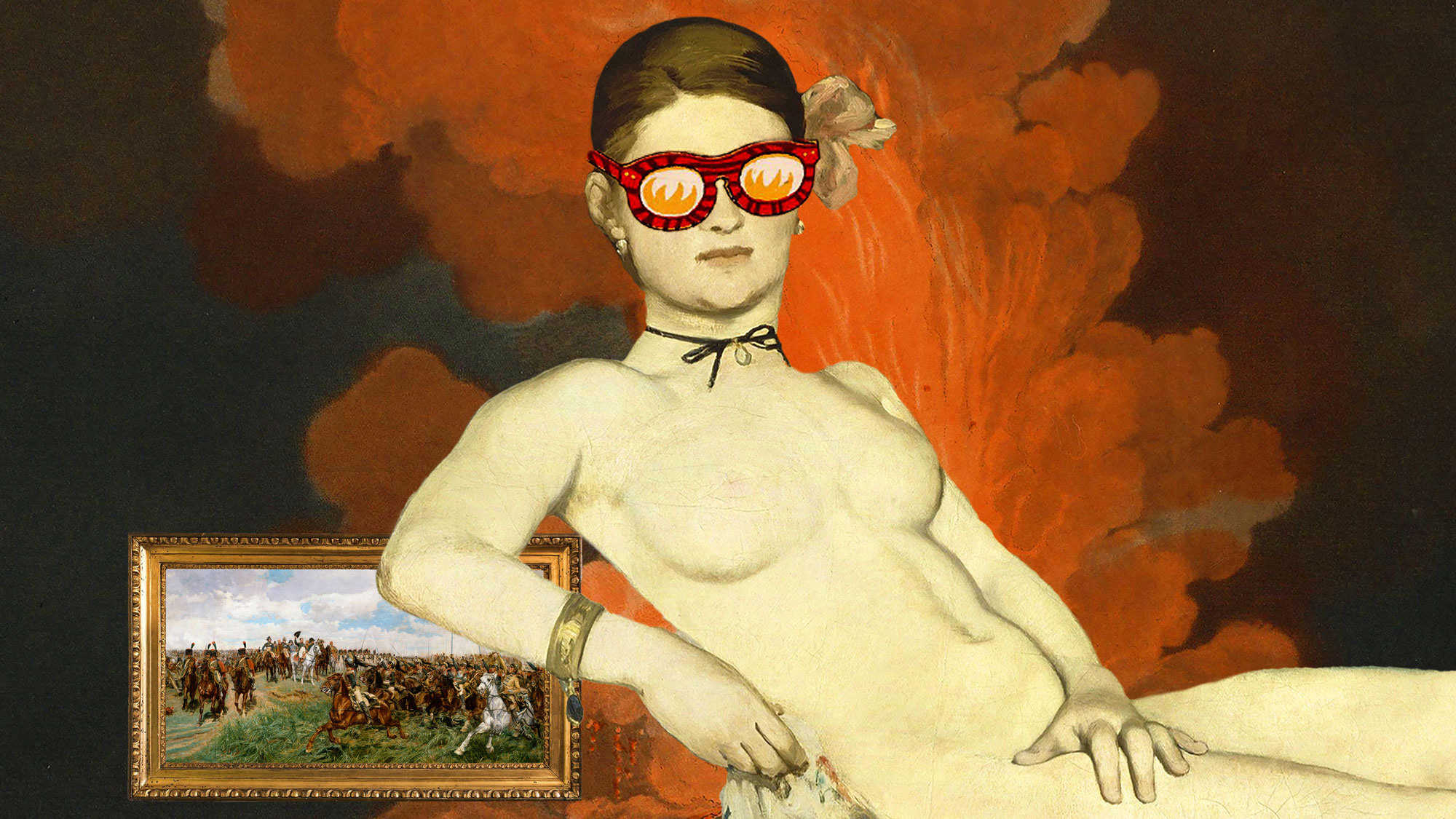
“Time gives every human being his true value.”
Truer words were never spoken, especially when one considers their source. Uttered by none other than Jean-Louis Ernest Meissonier, the previous formulation proved yet another of the celebrated painter’s attempts to measure his own gargantuan “fame,” “worth,” and “glory” for posterity. That this giant was forced to assay his own reputation during a remarkably turbulent age bedeviled by fabulous wealth, great inequities, republican strivings, social instability, dictatorial ambitions, and rampant epidemics speaks to the fundamentally unstable nature of artistic achievement…. Wait, who?
Behold the salutary tale of one of art history’s biggest losers. The “world’s wealthiest artist” during France’s Second Empire (1852-1870), Meissonier was, among other things, a preening perfectionist, a stiff-lipped haute-bourgeois weighed down by medals and honors, a stuffed shirt known for his “incredible hauteur and colossal self-regard,” and, as his future reputation bore out, the epitome of stodgy Académie des Beaux Arts taste. The fact that Meissonier was also an artist who lived like royalty with scores of servants in a massive chateau in Poissy, a small town a dozen miles outside Paris, reinforces the idea that, during his own lush lifetime, this once famous artist never met an establishment value—social, economic, religious, cultural, political—that he wouldn’t boost.
The top-of-the-line model among Paris’ officially sanctioned history painters, Meissonier got rich and famous by producing meticulous little paintings of traditional figures he termed his bonshommes, or goodfellows. That these romanticized, crowd-pleasing subjects drafted from an earlier age of swashbuckling chivalry—his cavaliers appear to have stepped right off the pages of Alexandre Dumas’ bestseller The Three Musketeers—provides one indication of the artist’s conservative worldview. His illiberal ethos was further illustrated by a meticulously rendered, sanitized, heroic version of establishment history: as in Friedland (1807), his most ambitious military painting. In the apogee of the historical realism movement that invaded painting and sculpture under the reign of Louis Bonaparte, Meissonier’s reactionary view of art reigned supreme during his lifetime. His principal opposition: the experimental, abstracted, subversive Realism and Impressionism of lesser known colleagues like Gustave Courbet, Edgar Degas, Paul Cézanne, Claude Monet, Camille Pisarro, and Édouard Manet.
In history’s retelling of the battle between art as received wisdom and painting as an exercise in critical thinking, it’s usually Manet that is cast in the role of David to Meissonier’s Goliath. While Meissonier grew rich by giving powerful patrons what they wanted—Napoleonic battle scenes and folksy views of pre-industrial France— Manet experimented with a slew of previously untried methods and subjects. Among these were the use of loose brushwork and shallow pictorial space, bohemian scenes, views of modern Parisian street life, tragedies pulled from the newspapers, and updated re-workings of dark painters like Goya and Velázquez. The fact that Manet’s canvases—among them Olympia (1863) and Dejeuner sur L’Herbe (1863)—were mostly rejected by the Académie for the Salon, its most prestigious biennial show, speaks volumes about his attempts to synthesize, in oil on canvas, the boulevard-level effects of certain norm-busting technologies—among them, photography, the telegraph, and the railroad. Meissonier, on the other hand, repeatedly received the Salon’s highest award for conventional miniatures and glorifications of war. He was also, predictably, the first artist to receive the Grand Cross, the nation’s highest order, at a time when France’s Emperor was more Mohamed Bin Salman than Queen Elizabeth.
Meissonier’s reactionary view of art reigned supreme during his lifetime.
As Ross King writes in his 2007 book, The Judgment of Paris: The Revolutionary Decade That Gave the World Impressionism, the fortunes of both artists are amply illustrated through the contemporary and posthumous fate of their respective masterworks. After going unsold during the artist’s lifetime and eliciting ridicule at the 1865 Paris Salon, Olympia retains pride of place at the Louvre today, where it has been rightly eulogized by art historian T.J. Clark as “the founding monument of modern art.” Meissonier’s opera prima, Friedland, on the other hand, suffered a fate all-too familiar to followers of modern-day speculative markets. It was sold, sight unseen, by the artist in 1876 to the American department store magnate Alexander T. Stewart for the record shattering of sum of $60,000 (that’s more than $1,190,000 in today’s dollars). After changing hands several times among Gilded Age one-percenters, it was gifted to New York’s Metropolitan Museum in 1887. Nowadays, visitors to the Met can admire it briefly as they pass into one of the institution’s biggest draws: the “Manet Room,” an elegant burgundy-colored gallery that contains no less than nine canonical canvases by the man many art historians regard as the father of Modernism.
Described by King as the “two opposite poles of art,” the diverse fortunes of Manet and Meissonier reveal more than mere historical anecdote. Despite much revisionist wear and tear—the product of necessary reexaminations of the history of European modernism—Manet’s principal legacy remains largely intact. In the words of the art historian Beatrice Farwell, Manet was “among the first to take serious risks with the public whose favor he sought, the first to make alla prima painting the standard technique for oil painting and one of the first to take liberties with Renaissance perspective and to offer ‘pure painting’ as a source of aesthetic pleasure.” Additional credit accrues to the man once called “The Apostle of Ugliness.” Manet didn’t just pioneer the inclusion of questionable taste and politics in art, he also painted real-life women and men, rejected unexamined portrayals of power and the powerful, and generally returned a fundamental license to generations of artists: the right to represent the events of their time.
Meissonier’s artistic methods, by contrast, look increasingly like those used by certain money-besotted, market-inspired artists of our own era. Like Jeff Koons— currently the world’s most expensive living artist—Meissonier’s artistic fortunes were arrived at after a long public engagement with the financial elites of Europe and America. These Belle Epoque pashas bankrolled his mansions, tennis courts, and yachts, so long as he churned out what they wanted: highly conventional pictures that flattered the rich and their tastes as beautiful, powerful, pious, and upright. In the 19th century, English gentry, French bankers, and American robber barons vied to acquire Meissonier’s canvases years before they were painted; in the 21st, High Net Worth Individuals buy and sell Koons “futures,” i.e., promisory notes for works yet to be produced. Then, the worm turned—for Meissonier at least.
The previous chapter of art history invites loads of conspicuous questions and comparisons. Among them are these: Will a global economic downturn and a planetary pandemic act as correctives to the ongoing financialization of art? Is Jeff Koons the Meissonier of our time? Who is the next Manet?