Catherine Millet
Juan José Santos
Published the 3 May 2022
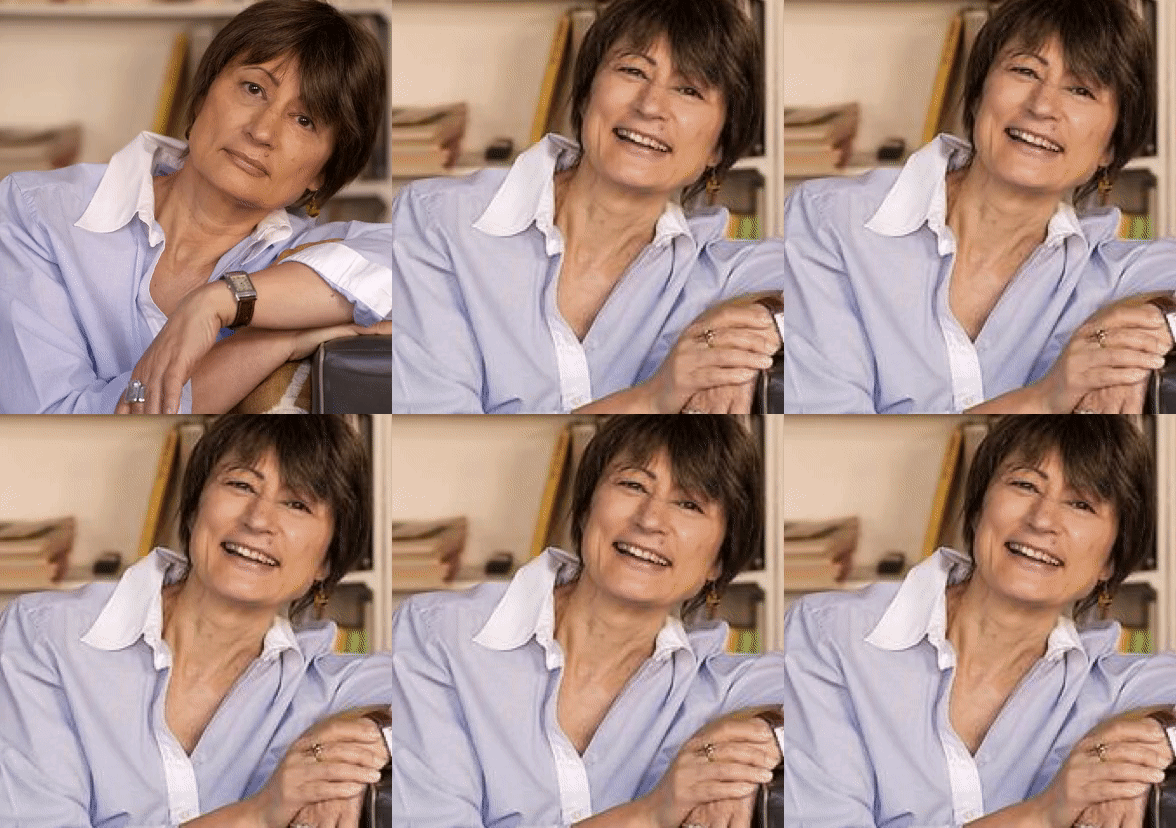
When I founded Art Press with Daniel Templon 50 years ago, I had a vision.
I think that, until the end of my life, or that of Artpress, I will be looking for the magazine that I dreamed of at the beginning. It must be emphasized that, in 1972, I had little experience and, therefore, did not have clear ideas. In fact, I am always devastated by the internal struggle between an ideal pure and simple, a magazine that would be crystal clear as a masterpiece of art, and the pragmatism that must be applied in day-to-day work. The one thing I’m 100% proud of is that we’ve maintained a financial independence. The consequence is that life is very hard (especially at the moment), but we are free to speak.
In the first number, I declared that I wanted to end the habits of xenophobia in French culture.
I started working in a traumatic context: the Parisians had not digested the fact that they were no longer at the center of artistic life, that the best creators had emigrated to New York. Some people looked at us as if we were traitors because we were interested in American painting, minimal and conceptual art. Judging us in an inappropriate way, because we were also closely linked to artists on the French scene.
I also explained that the magazine refused to take a journalistic perspective, that it relied too much on anecdotes…
I began to publish with Lettres françaises, the newspaper directed by Louis Aragón. It was surely the most serious and most prestigious cultural newspaper of the time, but the section dedicated to the plastic arts was in the hands of some gentlemen who had a very subjective approach, and they really liked to tell anecdotes or “little stories”. That is what they called “journalistic.” On the other hand, the most recognized international French critic was Pierre Restany. I really liked his character and his commitments, but I found his lyrical style a bit ridiculous! We were under the influence of the language sciences. We read Roland Barthes, Tsvetann Todorov, Jean-Louis Schefer and Hubert Damish. We were in search of a theory of arts.
But there are many anecdotes to tell about what has happened in these 50 years. The art critic that raised the most blisters was…
The criticism that has fascinated me, and, at the same time, has bothered the art world the most is that of Clément Greenberg. We have been very interested in the artists who defended him, I did an interview with him, but we have also published texts by Rosalind Krauss and Michael Fried who settled accounts with him. And then, we have published a lot about Harold Szeemaan, who was not an art critic, but who has built a history of art very different from Greensberg’s.
I have also argued with some critics.
I often say that my best friend is Jean Clair. His culture is so vast, and his insights are so pertinent. But his taste was reactionary and some of his stances were in bad faith. I also liked having contradictory discussions with Jean Hebert Martin and with Nicolás Bourriaud. That helps to think. However, good debates are dying out. At least in France.
Art criticism has changed a lot in the last 50 years.
I miss that there is no longer such a vision. I am not talking about theory, but about an understanding of the different tendencies in connection to others, and the analysis of intellectual challenges. Too many circumstantial and subjective criticisms…
What interests me most about current contemporary art is…
I am particularly attentive to the renewal of geometric painting (Peter Halley, John Abbott) and sculpture (sometimes practiced by women, such as Berlinde de Bruyckere.)
The exhibition that has excited me the most this year is the Guillermo Kuitca retrospective at the Villeneuve d’Ascq Museum. During the current year, I have written about Gilles Barbier, Roméo Mivekannin, Carlos Augusto Giraldo (Colombian brutalist artist), Johann Le Guillerm (circus artist) and John Abbott, already mentioned. I have a particular interest in the extension of contemporary art which, in fact, includes gross art, the art of the marginalized, some traditional practices such as ceramics (but not all)…
If someone asks me what I would like ArtPress to be like in 50 more years…
As a reliable source for historians.
You can love a work of art without knowing anything about the biography of the artist.
Of course! And I have even liked works without knowing the names of the artists. But I don’t think it’s necessary to resort to some biographical elements if we don’t know them. In fact, some works are openly and deliberately autobiographical. How to ignore it?
I wanted to analyze the work of Dalí and Yves Klein because…
Klein, because he represented the quintessence of the avant-garde gesture and, when I wrote the book about him, we were in the middle of the postmodern period! Dalí, because no other work allows to understand so well the operation of the scopic drive.
If Dalí were alive today…
It would be good! The art world needs to laugh at itself. Maurizio Cattelan is so pale next to Dalí!
I wrote about my memories of May ’68 for Art Review. And I said things like post-May 68 generations went to art school much more spontaneously than their predecessors.
I miss a little the creativity of the self-taught and their “non-professional” conception of the artist’s life.
In all the interviews that have been done to me, they first question is about the manifesto against #metoo, then about sex, and then about art.
To be exact, it all depends on “who” you ask me. For example, in this quiz you don’t tell me to talk about #metoo. I prefer contemporary art to remain a matter for specialists.
When The sexual life of Catherine M was published I lost or gained adepts in the art world? Neither one nor the other.
The book I’m reading right now is…
Herman Melville’s White-Jacket.
Yes, I have seen the list of nominees for the Marcel Duchamp Prize.
But I confess that I have forgotten her.
By the way, I would like to say something about Duchamp.
‘Marcel Duchamp’s silence is overrated’ in the same way as his art…
The last masterpiece I’ve seen in the cinema is…
Freedom of Albert Serra and Annette of Leos Carax.
My relationship with gallery owners changed.
I think that the health crisis has strengthened the ties between the actors in the art world and, above all, between dealers and critics. I find that relationships are more authentic. But it may be a very personal impression.
A dream to fulfill is…
Have time.
Translated from French by Pablo Ángel Barrios Martínez