Carolina A. Miranda
Juan José Santos
Published the 27 November 2021
Illustration by Carolina A. Miranda
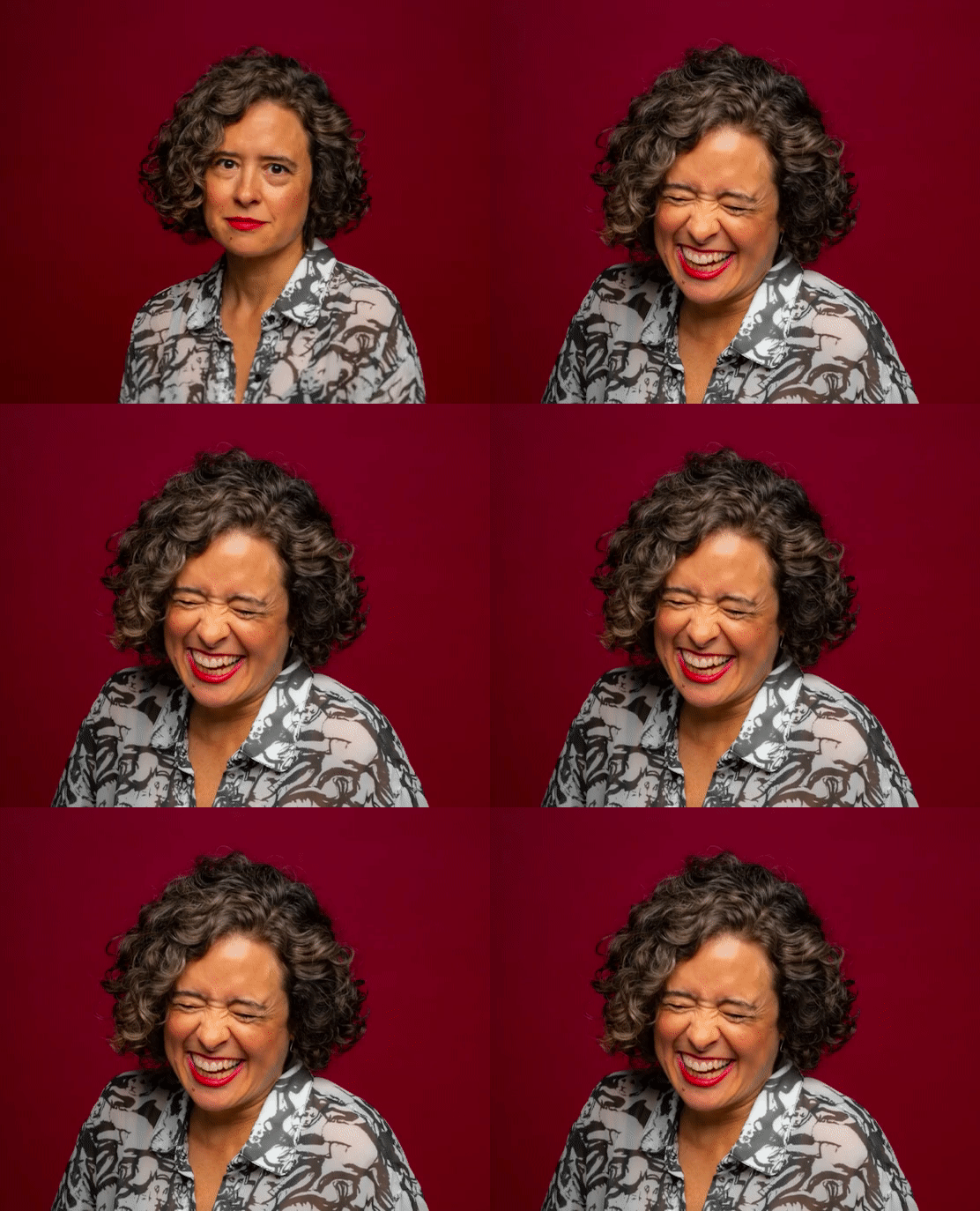
The main difference between being an art critic in LA and in New York is…
The mindset. New York is more market; L.A. is the petri dish where things percolate. New York is linear time, it’s the centralized brain issuing commands in Madeleine L’Engle’s “A Wrinkle in Time.” L.A. is Thomas Pynchon’s “Inherent Vice,” where you go on a really long journey and all of these incredible things happen, but at the end of the day, you somehow end up right where you started.
First thing I see when I’m admiring a building is…
The way it sits on the street and how it connects to (or doesn’t) to the street and the buildings around it. I feel like that tells you so much about the generosity of an architect. How willing are they to let their design defer to their environment? Will they step back to let a neighbor receive sunlight? Do they provide a welcoming space in which to greet pedestrians? I’m all about the first impression. After that, I look materials. Then I look at the bathrooms.
The ugliest building in the world is…
Philippe Starck’s Asahi Flame building in Tokyo. I’ve only seen it from the outside, but all I have to say is that it’s nickname — the Golden Turd — is very kind.
I think that addressing the Latino community in the States as Latinx is…
Is fine by me if that’s what you prefer. Though, personally, I refer to myself as LatinXXX.
When I told my parents that I wanted to be an art critic their response was…
Honestly, I never thought about becoming a critic. It just kind of happened. My mother wanted me to be a lawyer. And I think my dad was grateful that I didn’t really ask him for money after I left the house.
There is a review I wrote that I regret.
Yes. Too many to count. And no, I’m not going to tell you which ones they are. Unfortunately, in this profession, the learning curve is public.
If I were to give a negative review to an artist friend…
This is why I try not to be friends with too many artists. It’s complicated.
If museums are to survive, they must…
Stop investing so much in ridiculous buildings and instead invest in employees. A museum guard charged with the safekeeping of priceless works of art shouldn’t have to work three jobs to survive. It’s downright feudal.
The fundamental element to being a good art critic is…
If you figure this out, please tell me. But in my case, I think it’s about trying to be a good reporter and thinking, above all, of the reader.
For me one of the most underrated artists is…
Patssi Valdez. She was a founding member of the Los Angeles art collective Asco (with Harry Gamboa Jr., Willie Herrón and Gronk), which made a name for itself in the 1970s for spraypainting the Los Angeles County Museum of Art. Over the last few years, Asco has gotten a lot of ink. But I feel like in a lot of coverage, Patssi is often treated as a muse rather than as a critical and active participant. She has a archive of photography that I’d love to see presented in a thoughtful way. Hopefully some curator somewhere agrees with me.
And the most overrated artist.
Beeple.
The TV serie (Netflix, HBO, Amazon …) I recommend to everyone.
“Le Bureau,” a French spy show on the Sundance Channel. Brilliant and devastating.
Latin art in the United States is still considered…
I’d say historically, art by Latino artists has been treated like folk art. But we’re now in this transition moment where work by Latinos seems to be gaining serious consideration by major arts institutions. Here’s hoping the phenomenon lasts and that it’s not simply box checking. Latino underrepresentation in our culture is what made figures like Trump possible. There was a narrative vacuum and he filled it. And the institutions of culture are partly responsible for that. They could have been offering a counternarrative and they didn’t.
Something I can’t stand in the art world is…
Artspeak. It’s especially heinous when it emerges out of institutions that purport to serve the public. Only the art world could come up with a term as cockamamie as “time-based media.” It’s as if one day someone said, “Let’s take the word ‘video’ but make it infinitely more complicated.”
If you had to choose between seeing a brilliant art exhibition or eating a mole taco at Quesadilla González…
That’s hard because they both nourish, but I’d have to start with the taco.
The worst comment I got when I had my C-Monster blog.
Oh, that’s a tough one because that was a long time ago and the pandemic has destroyed the few brain cells I had left. But the best letter I ever got at the L.A. Times was a guy who wrote me a one-sentence note that went: “You went to Smith for this?” I have it pinned above my desk.
What I did when I was notified that I had been awarded the Rabkin Prize for Visual Arts Journalism.
I was in the parking lot of the LA Times printing plant at the moment I got the call and couldn’t quite believe it. Then I went home and downloaded the foundation’s IRS 990 tax forms to make sure the whole thing was legit.
What I would do with the Columbus monument.
I’d say it depends on the monument. Some of them, should no doubt, come down and be replaced with something else. Columbus has had a 500-year run; it’s time for some fresh narratives. But there are some that I would leave up and then add something that recontextualizes them. I’ve been reading about the work of artist Joiri Minaya, who cloaks colonial statues in fabrics of her own design. These often bear bright floral patterns inspired by ethnobotanical traditions and colonial histories. I’d love to see those installations in person. And generally I’d love to see statues of Columbus (or any other colonial figure, for that matter) used in that way — as an opportunity for artists and others to talk back to history.
The first time I read John Berger…
I will confess that I saw Berger’s TV series waaaaay before I ever read him. It was in high school, in a political science class. I must have been like 15 or 16 years old. But Berger’s analyses of the representation of women in art really stayed with me — of the ways in which the female model has been sexualized and frequently portrayed as available. That, to me, was formative, because it wasn’t simply an analysis of whether a painting was good or not, but instead was about something much more important: power. And if there’s one thing I’ve learned in this racket it’s that art loooves power.