Ai Weiwei vs Antonio Vega Macotela
Juan José Santos
Published the 31 December 2020
Illustration by Danila Ilabaca
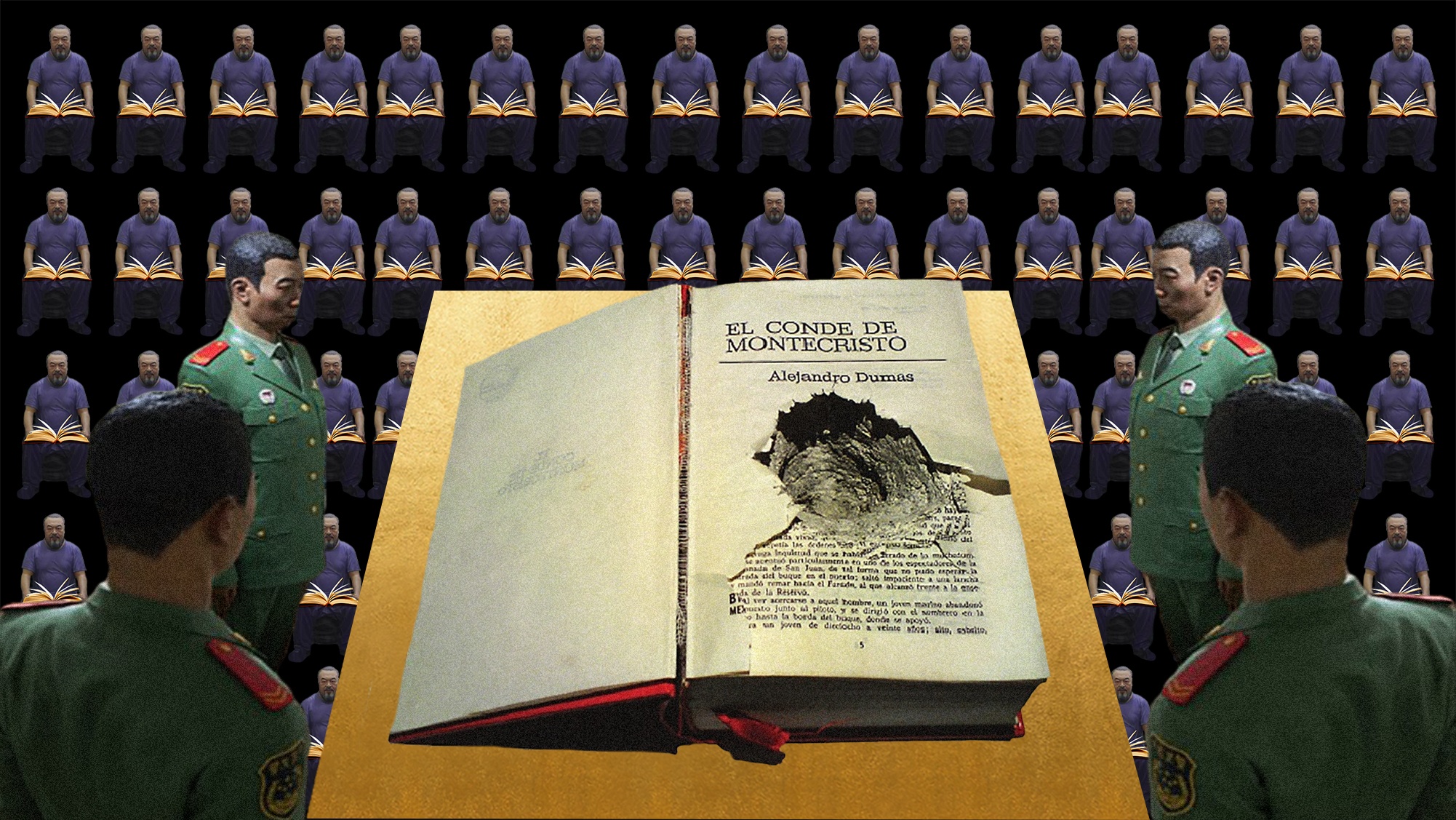
Gao Ying is observed very closely. She lowers her head slightly and focuses her gaze into the narrow opening of a huge black box. Although Ying forces a steely smile, she can’t help but feel moved when she sees what’s inside the container. She recovers her poise—after almost crying—and turns back toward her pursuers. She is the artist’s mother. They are reporters from international media, tourists, the looky-loos of the art world who are also part-time consumers of the carved and painted saints—like Lazzaro Bastiani’s The Descent—that decorate the Church of Sant’Antonin. They also appear near tears, like the artist’s mother. We are at the 2013 Venice Biennale, at the opening of S.A.C.R.E.D., an installation designed to praise Ai Weiwei to the skies by the grace of art. He will not be canonized for his life and miracles, but at the request of his followers.
If S.A.C.R.E.D. is the dessert, then Dumbass is the first course: a musical number written by Ai Weiwei, scored by Ai Weiwei, and performed by Ai Weiwei, based on the time Ai Weiwei spent in detention. The video was surely encouraged by the success of his 2012 YouTube Gangnam Style parody, in which he appeared handcuffed while dancing his famous dumbsong. It was bound to be a hit! Dumbass not only provokes laughter by picturing the artist crossdressing and goofing around with scantily clad girls, it also implicates the viewer in the artist’s fight against the Chinese Government, which kept him in a tiny cell for 81 days under 24-hour surveillance after being accused of tax evasion. Dumbass fulfills its mission brilliantly, shaming a despotic regime, vindicating the life of the dissident—“Fuck forgiveness, tolerance be damned, to hell with manners, low-lifes are invincible”, he sings in one verse—while helping the artist escape from censorship and opening him up to a general public who may access his work from the comfort of their living room and through a free platform. Of course, navigating YouTube channels is not the same as navigating Venice’s canals.
Like Gao Ying, I was also in Venice. I bent down to look through the slits cut into the six heavy iron boxes deposited in that sacred space—by which I mostly mean the church, but also the biennial—to observe the nearly biblical passages represented by a statuette of the artist enacting daily routines alongside two miniature soldiers. Unlike Ying, I found it hard to get emotional. Not a bit. Not at all, really. Ai strives to have us interpret his biography as art, not caring that critics value artworks, not events, no matter how deplorable. His cards are rigged, but I will not fall into a trap created by an artist who would drag me into his vicissitudes and have me observe his supposed miracles, like his “years in the desert” (there are those who say that the artist dedicated his time between 1981 and 1993 in New York to learning how to be Duchamp, but this would only be true if blackjack was considered a ready-made), or whether he was critical of the Chinese Government when he collaborated in the construction of the National Stadium in Beijing, or whether his dissent has more to do with taxes (paradoxically, he threatened to leave Germany, the country that welcomed him as a refugee, due to its high taxes), or to ponder the deactivation of his activism, like when he chose to exhibit in a shopping center and held hands with Paris Hilton. There is no doubt that Ai Weiwei is as much a victim of Chinese authoritarianism as he is of his own obsession with fame. But we are not here to judge China’s legal system. But to judge art.
I found it hard to get emotional. Not a bit.
Ai is a bad prisoner. But is he a good artist? Many will agree that he is not, especially those who have memorized the photograph in which he infamously poses as Aylan Kurdi, the boy found drowned on a beach in Turkey. Others will doubt the originality of emblazoning Han Dynasty vessels with the Coca-Cola logo, or be bored by the repetition of certain patterns (turning a life preserver into a marble sculpture, a chair into a marble sculpture, a baby carriage, a sofa, doors in marble sculptures…). Ai is not an artist who generates works with interpretive layers. The photograph of his raised middle finger in front of the Eiffel Tower does not elicit too many metaphors. Perhaps the greatest criticism of his work is that he stands as the protagonist of many of them, especially those that are inspired by his 81 days of captivity, which have generated years and years of artwork. This has been true at last since the WeiweiCam, the fifteen surveillance cameras that recorded him night and day in 2012—it’s dated the same year he made a surveillance camera from, you guessed it, marble!—to Man in a Cube, a negative of his body carved into concrete in the old Wittenberg prison in 2017.
Between these works lies S.A.C.R.E.D., his Gulag Archipelago in which all the prisoners are him; the acronym made up of the initials of the six “parables” illustrated by his three-dimensional comic: Supper, Accusers, Cleaning, Ritual, Entropy and Doubt. These synthesized didactic scenes, displayed in a church, lead me to the following conclusion. That his mother’s presence at the opening—the artist was held by the Chinese government at the time—was no mere anecdote but instead part of the artist’s creative logic. Rather than memorializing his imprisonment in marble he turned the classical Pietá into a flesh and blood performance. Ai’s logic here is clear: he is a martyr, and his saintly attribute is a security camera. S.A.C.R.E.D. is designed for the spectator-tourist of the Biennial, following a scheme assumed by the general public. The vignette—its mastery in the use of universal languages is the key to its acceptance—both infantilizes and dwarfs interpretation. The viewer’s vision is also reduced, as well as their reading of the work, which loops like a closed surveillance circuit, begetting affectively flat reflections. “They are impressive, smart, and often gorgeous, but unaffecting” wrote Peter Schejdhal about these artworks. “Just about everything that Ai uses, materially or formally or symbolically, he uses up”. When you take your eye off the Venetian dioramas, you don’t think about the authoritarianism of a certain Asian country, but instead about how amusing poor, figurine-sized Ai Weiwei looks inside his dollhouses. It all seems closer to Gustave Courbet’s Self-Portrait in the Sainte-Pélagie Prison (1872), in which the painter appears in tormented bohemian costume, sporting a red scarf and a beret while smoking a pipe, than to Time Divisa, by Mexican artist Antonio Vega Macotela, who, though he was not himself imprisoned, spent way more than 81 days in jail.
Vega Macotela is an earthy artist, and in Time Divise (Time Currency) (2006-2010) he was true to his nature. He worked in the field. In the case of his own art, he is not the protagonist. His work does not speak of his lack of freedom, but of the lack of freedom of others. For four years he went to the Santa Martha Acatitla penitentiary in Mexico City to carry out 365 “time exchanges” with prisoners. The artist asked the inmates to perform an action and, in return, offered to undertake actions ordered by the inmates that they could not perform while locked up. The agreed upon actions—orchestrated by the prisoners and the artist—took place simultaneously. While Vega Macotela witnessed how the son of a prisoner took his first steps, danced with a mother, visited brothels, looked for a lost love, got drunk with old friends, the prisoners counted their heartbeats, described each scar on their body, sculpted soaps or wore an opening into an edition of The Count of Monte Cristo by scratching it with a single finger for thirteen hours.
Time Divise, the title of their artistic contraband, refers to a method of symbolic exchange in which transactions are effected with time instead of with money. The number of actions involved was 365, the days it takes the earth to orbit around the sun, which in most cultures counts as a lifecycle. Objective and subjective time intersect while clashing with capitalism, which undoubtedly has something to say in the case of most prisoners, mostly as witness for the prosecution. Authorship is also questioned. Rather than residing in the artist’s signature, the prisoner is made the co-author of a work, object or action, which in many cases achieves a high aesthetic value. Finally—and allow me an extemporaneous reading here—the work contains a longing for hope for those confined and kept isolated far from their loved ones. From the perspective of 2020’s global pandemic, this work contains additional treasures.
The result of these actions are displayed as graphic work, as editions: a collection of little acts of kindness that record the relevance of gestures, the stuff of which love and longing are made when time is abundant but not space, when there is memory but no touch, imprisonment instead of freedom. Despite the depth of feeling involved, there is no moralizing, no jailhouse romanticism; instead, there is an agreement arrived at by subjects trapped within the strictures of a system. One reveals the limitations of art; the other perhaps the consequences of bad decisions. A third way, that of Ai Weiwei, is all about narrowing the gaze.